
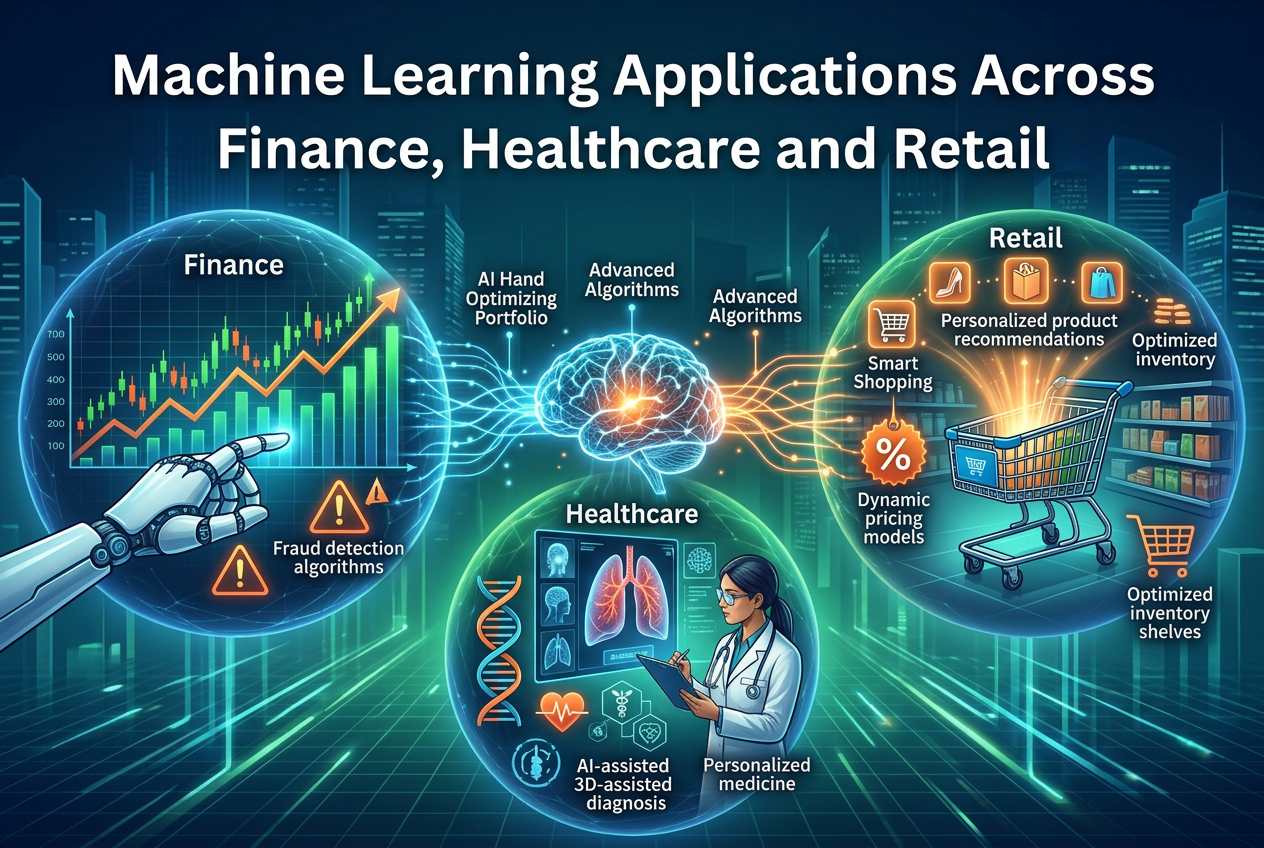
Machine learning is used to identify patterns in data and make predictions or classifications that support specific tasks. Businesses and institutions can apply it to problems that involve large amounts of information, recurring decisions or patterns that are difficult to identify manually.
The usefulness of machine learning depends on the quality of the data, the suitability of the model and the way its results are evaluated. Understanding its applications across finance, healthcare and retail helps explain why it has become an important part of modern data-driven systems.
What Is Machine Learning?
Machine learning is a branch of artificial intelligence in which algorithms learn patterns from examples. Instead of defining every decision through fixed rules, developers train models using data and evaluate how well they perform on relevant tasks.
Common approaches include supervised learning, unsupervised learning and reinforcement learning. Supervised learning uses labelled examples, while unsupervised learning explores patterns in data without predefined labels. Reinforcement learning involves learning through interactions and feedback.
Not every business problem requires machine learning. Rules, statistical analysis and traditional software can be more suitable for many tasks.
1. Machine Learning Applications in Finance
Financial organisations process transactions, account activity, credit information and market data. Machine learning can help identify unusual patterns and support risk analysis.
Fraud detection
Models can flag transactions that differ from typical activity, such as unusual transaction sequences or unexpected changes in behaviour. These alerts help investigators prioritise cases for review.
An alert is not proof of fraud. Systems must balance detection performance with the risk of incorrectly flagging legitimate customers.
Risk assessment
Financial institutions may use models to estimate certain forms of risk based on relevant historical information. Such systems require careful validation because poor data, bias or changing economic conditions can affect their results.
Financial forecasting
Models may analyse historical patterns to support forecasting and planning. However, financial markets are influenced by many unpredictable factors, so model predictions should not be treated as guarantees.
2. Machine Learning in Healthcare
Healthcare organisations generate information through appointments, clinical records, diagnostic processes and hospital operations. Machine learning may support selected administrative and analytical tasks.
Operational planning
Hospitals can analyse historical appointment and admissions data to understand demand patterns and plan resources. Forecasting may help with scheduling, although unexpected events and changes in patient needs can affect accuracy.
Medical research
Researchers may use machine learning to explore large datasets and identify patterns that warrant further investigation. These findings need appropriate scientific validation before being treated as reliable conclusions.
Clinical support
Some AI systems are designed to assist with medical image analysis or other clinical workflows. Such applications require rigorous evaluation, appropriate professional oversight and compliance with relevant regulations. A model’s output should not automatically replace clinical judgement.
3. Machine Learning in Retail
Retail businesses can use machine learning to understand demand, organise inventory and personalise customer experiences.
Product recommendations
Recommendation systems identify products that may be relevant to a customer based on appropriate information such as product relationships or previous interactions. Their performance should be assessed against actual customer needs and business objectives.
Demand forecasting
Retailers may analyse historical sales, seasonality and other relevant variables to estimate future product demand. Better forecasts can inform purchasing and inventory planning, although they cannot eliminate uncertainty.
Customer segmentation
Machine learning can help group customers with similar patterns of behaviour. Retailers may use these groups to understand shopping habits and improve services, while ensuring that customer data is handled responsibly.
4. Other Industry Applications
Machine learning also supports manufacturing, logistics, telecommunications and technology services.
Manufacturers may analyse equipment readings to identify patterns associated with potential failures. Logistics teams may use models to support route planning and delivery estimates. Technology companies may apply classification systems to filter spam or categorise support requests.
In each case, the business should define the problem before selecting a model. A system that performs well on historical data may not perform equally well under new conditions.
5. The Role of Data Quality and Model Evaluation
Machine learning systems learn from the data provided to them. Incomplete, inconsistent or biased datasets can produce unreliable results.
A typical workflow includes collecting relevant data, cleaning it, selecting an appropriate approach, training the model and evaluating it on data that was not used for training. The choice of evaluation metric should reflect the practical consequences of errors.
Models should also be monitored after deployment. Customer behaviour, operating conditions and data sources may change over time, reducing performance.
6. Skills Needed to Work with Machine Learning
Learners interested in machine learning generally benefit from a foundation in Python, SQL, statistics and data preparation. They can then progress to model training, evaluation and tools such as Scikit-learn.
Practical projects help demonstrate how these concepts work. A beginner might build a basic classification model using a public dataset, compare evaluation metrics and explain the limitations of the result.
People comparing data science training programs, including NUCOT’s offering, should check the curriculum, project work and support arrangements. They should also confirm current course details directly with the provider.
Conclusion
Machine learning applications across finance, healthcare and retail show how data can support fraud detection, operational planning, forecasting and customer experiences. However, the technology is only as useful as its data, evaluation and implementation. Organisations should choose methods that fit the problem, test performance carefully and maintain human oversight where decisions have significant consequences. For learners, understanding programming, statistics and data preparation provides a strong foundation for exploring machine learning responsibly